

Engagement, attrition, and transformation don’t run on a calendar. Why do your surveys?
For decades, employee listening has largely followed the same model: ask a broad group of employees a standardized set of questions, analyze the responses, and repeat the process periodically.
The problem is that those questions are often disconnected from what’s actually happening in the organization.
Last week, I spoke with a Chief People Officer about their annual survey. I asked which themes were most closely linked to outcomes like performance, productivity, or attrition. “We don’t connect the data that way,” he told me.
I hear versions of this all the time. Companies collect a lot of employee feedback without knowing which responses are actually associated with the outcomes they care most about.
That can also lead organizations to ask questions they don’t really need answered. A company might ask employees whether they feel involved in decision-making when its leadership team believes most decisions should remain centralized. Or ask employees to rate the company on transparency when increasing transparency isn’t actually a priority.
Meanwhile, the signals that should shape listening are emerging in the organization all the time. High performers start leaving in a critical function. New hires in one region are ramping much more slowly than their peers elsewhere. Two comparable teams begin producing very different results.
Those are the moments when employee input becomes especially valuable. Something meaningful is happening, and understanding the employee experience can help explain why and inform what to do next.
After working with thousands of companies on their people programs and designing and analyzing employee surveys across industries, our thesis is this: don’t start with a survey and then look for insight. Start with workforce signals, then listen where employee input can help explain or improve an outcome.
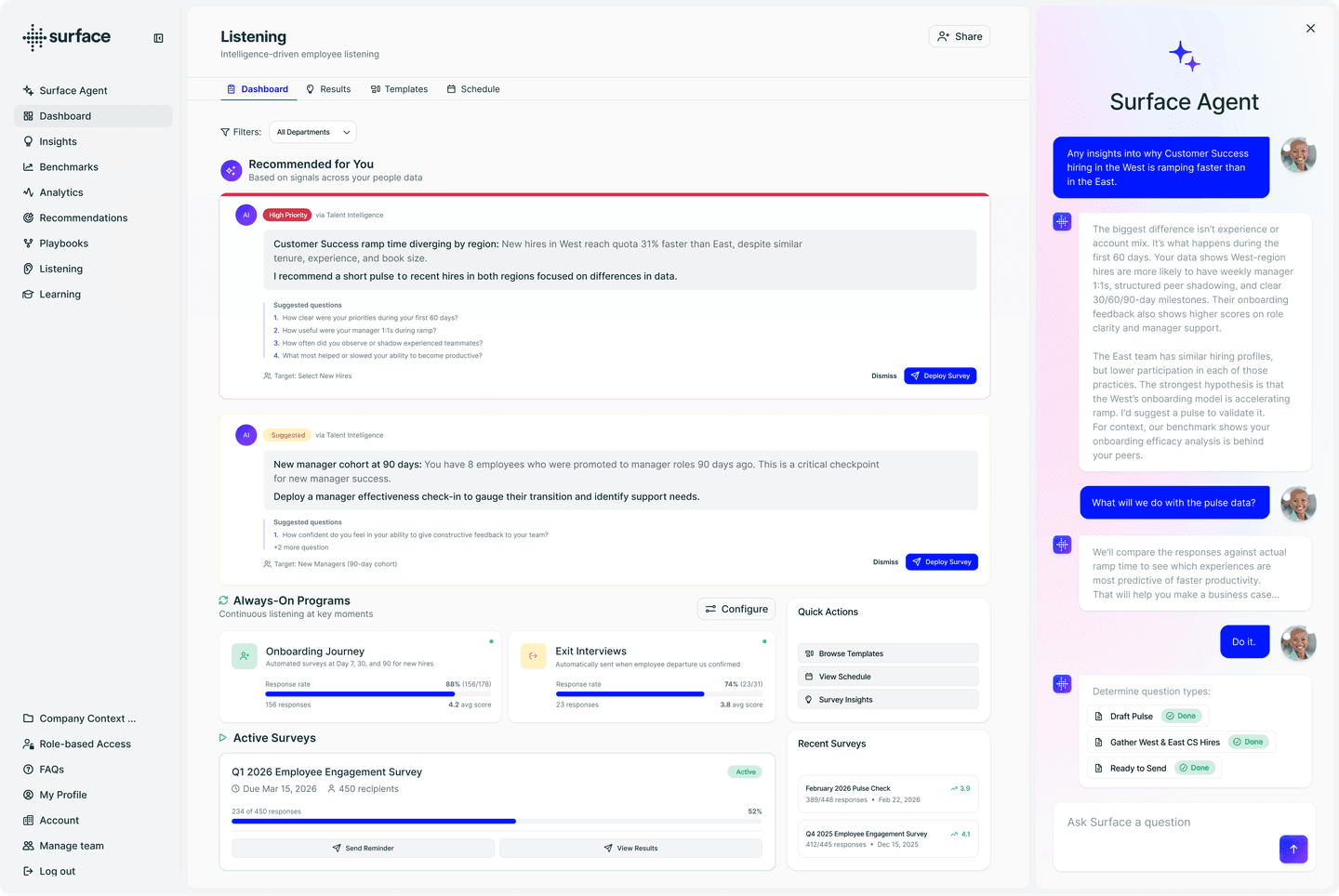
Today we're launching Surface Listening, an AI-native employee listening solution that can trigger and deploy surveys based on patterns it detects across your organization, interpret employee feedback in the context of broader workforce data, recommend what to do next, execute the work, and measure its impact.
Why Start with a Signal?
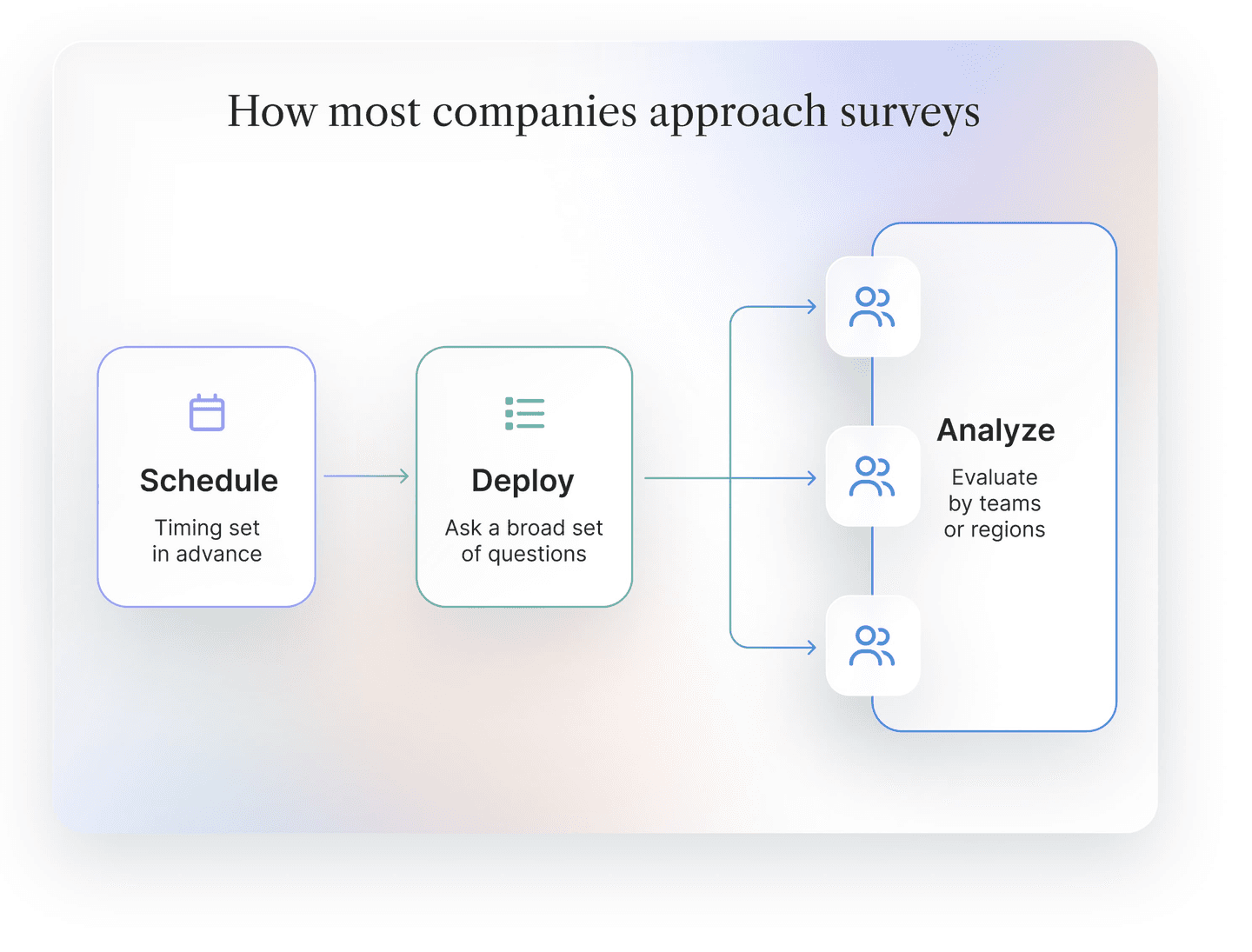
Traditional listening platforms made it dramatically easier to collect and analyze employee feedback at scale. But underneath the software is still essentially the 100-year-old paper survey model: ask a broad population a standardized set of questions on a fixed cadence, then analyze the results after the fact.
Employee listening in 2026 is typically pre-scheduled rather than triggered by what’s actually happening in the organization. Questions are most often inherited from standard engagement frameworks, not tailored to what’s happening in the organization or chosen because leaders need a specific answer. And the process typically ends with a dashboard and a broad set of recommendations rather than targeted action.
That creates two problems.
First, organizations waste time asking employees about things that may not be relevant to the decisions they are actually trying to make.
Second, every question creates an implicit expectation. If you ask employees whether something should improve, they reasonably assume it’s something the organization values and cares about improving. When companies repeatedly ask for feedback and don’t act, employees start questioning why they are being asked at all.
It’s no surprise that leaders increasingly worry about survey fatigue. This year, our data show that 53% of companies run engagement surveys only once a year or less.
But the answer isn’t to listen less. It’s to listen differently.
AI gives us an opportunity to rethink the model, not simply make the existing approach more efficient. Listening can move from “What questions should we ask this year?” to “What’s happening in our organization that we might be missing? What are we trying to understand or improve? And where would employee input help us make a better decision, right now?”
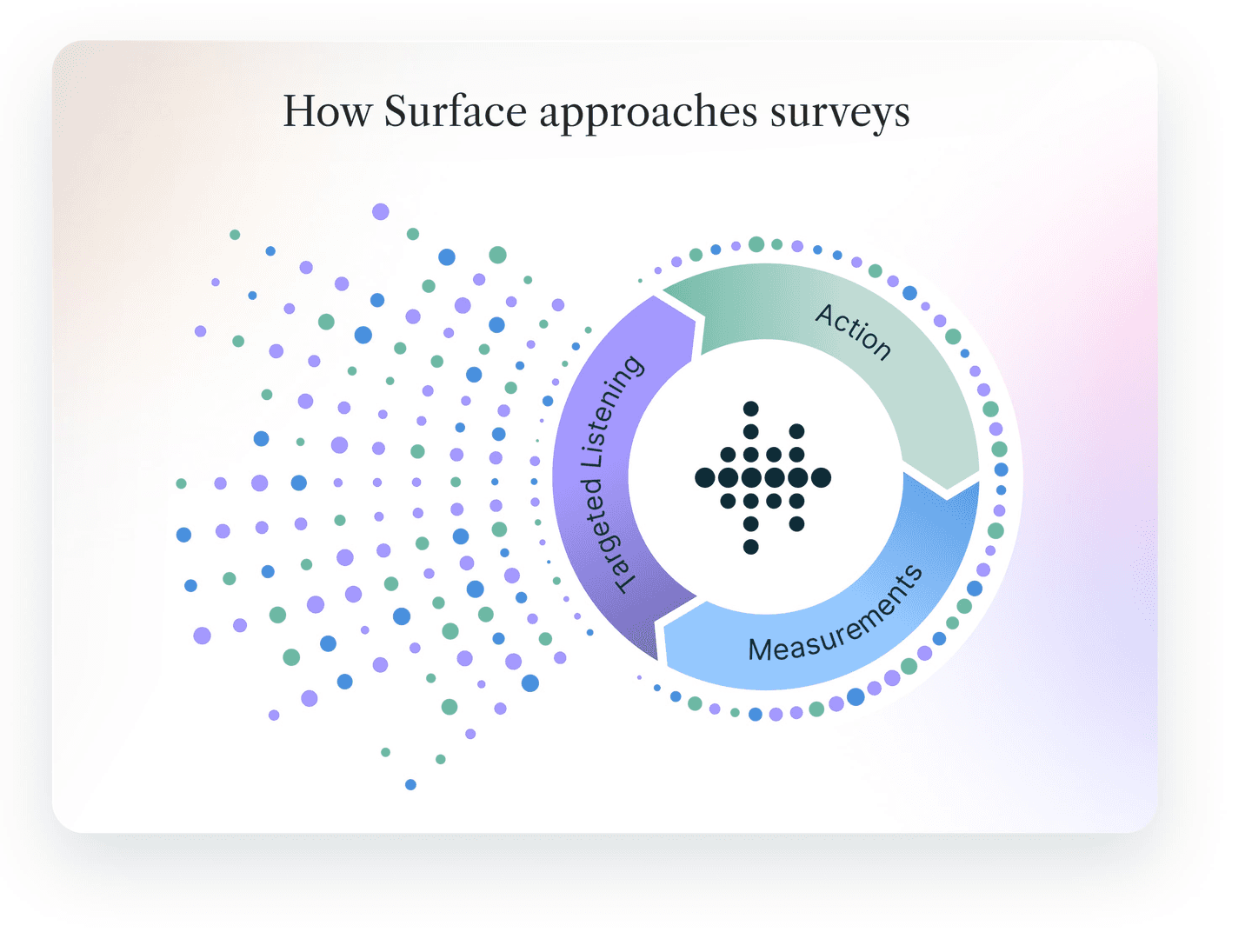
Surface can take this approach because Listening isn’t operating in isolation. It’s part of the same people intelligence layer already looking across your workforce data, organizational practices, and business context.
How Surface Listening Works
Surface continuously looks across signals in your organization, including HRIS data, performance, hiring and attrition, workload, learning, policies, benefits, and the practices that often live only in your team’s heads.
When it identifies something worth understanding more deeply, Surface recommends the right kind of listening, the right questions, and the right employees to hear from.
That might mean:
A targeted pulse based on an emerging signal. If Surface detects an unusual retention pattern, a performance gap between similar teams, or signs of manager strain, it can recommend a quick pulse to hear from the people closest to what’s happening.
Listening at key moments in the employee journey. Surface can automatically gather feedback around onboarding, exits, team changes, manager transitions, and major organizational shifts, adapting the questions to your organization and the moment.
Broader listening when a company-wide view is useful. Surface also supports comprehensive engagement programs, organization-wide pulses, and custom questions, alongside more targeted listening.
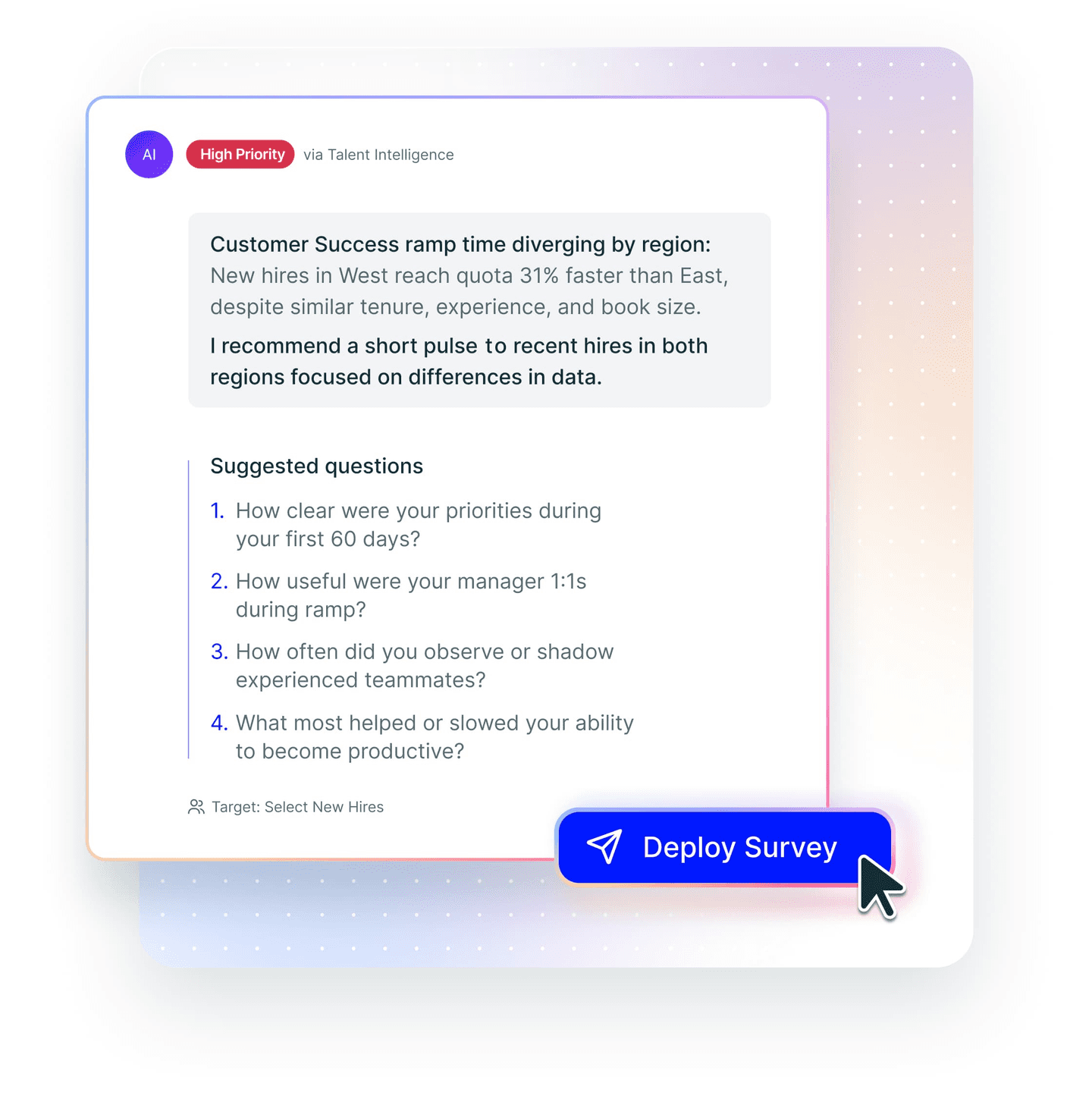
The goal isn’t to ask more questions. It’s to ask fewer, better questions when the answers can actually inform a decision or action.
Once employees respond, their feedback becomes part of the same intelligence layer Surface is already using to understand the organization.
So if Surface identifies declining performance in a particular segment and recommends asking those employees a targeted set of questions, it can analyze what they say alongside workload, attrition, manager changes, tenure, organizational structure, and other workforce data.
And it can go further by benchmarking not only outcomes, but the practices driving them. Knowing that your engagement score trails peers is useful. Knowing what higher-performing organizations are doing differently gives you somewhere to act.
And action is the point.
Based on what it learns, Surface recommends next steps and helps create the work required to make them happen. That might include an executive readout, manager guidance, employee communications, a new program or policy, or a detailed implementation plan grounded in Paradigm’s experience working with thousands of organizations.
Then Surface helps leaders understand what happened after they acted.
A company might identify an issue, test a new approach with several teams, and then look at subsequent employee feedback alongside retention, performance, mobility, or other outcomes to see whether things improved.
That creates a continuous learning loop:
Signal → Listen → Understand → Act → Measure → Learn
Over time, organizations can build their own evidence about which programs, practices, and interventions actually produce better outcomes.
The Future of Employee Listening Starts Now
For a long time, scheduled surveys were one of the best tools available for understanding what employees were experiencing.
But the moments that matter don’t follow a survey calendar.
Teams change. Attrition patterns emerge. New managers struggle. Programs roll out. One part of the business starts outperforming another.
And not every topic deserves a question just because it appears on a standard engagement survey.
The future of employee listening is more intentional: know when there is something worth understanding, ask the people closest to it the questions that matter, act on what you learn, and measure whether anything changed.
Surface Listening is available now.

Joelle Emerson
Co-founder & CEO, Paradigm
Before founding Paradigm, Joelle was a civil rights lawyer. Joelle’s legal background highlighted the consequences that can result from companies failing to consider culture early, and inspired her to found Paradigm.
Get new posts by email
Research, product news, and practical strategy for people leaders. A few times a month, no more.
More from the blog

Insights
Build vs. Buy AI: A Framework for Enterprise Software
AI has made it dramatically easier for companies to build their own software, and that creates a new problem: companies building far more than they should. Six questions to ask before you build instead of buy.

Leadership
From HR Leader to Transformation Architect: The New Role of the Chief People Officer
As AI reshapes how work gets done, the Chief People Officer’s role is expanding. Discover the three critical responsibilities CPOs should own to help organizations adapt and thrive.

People Intelligence
How to Bridge the HR Insight-to-Action Gap (It’s Not Another Dashboard)
Most HR tools leave teams stuck in the insight trap. Learn how a new category of multi-signal, action-oriented platforms like Surface turns data into ready-to-execute talent and culture strategies.