

We started Paradigm with a simple belief: the team you build is the company you build, and how you build that team really matters. The choices companies make about who they hire, how they organize, what they reward, and the culture they create ultimately shape what those companies are capable of achieving. We believed organizations could be far more intentional—and far more strategic—about those choices.
Twelve years later, after working with thousands of clients, we’ve learned a lot about what it takes to build healthy, high-performance organizations. Paradigm started as a consulting firm, but in 2020, we began building software to scale the expertise, insights, and practices we had developed through that work. Then, last year, we saw an opportunity to build something fundamentally different.
Rather than bolt AI onto the products we already had, we decided to start from scratch. We asked ourselves: What would it look like to take an AI-native approach to building high-performance organizations? And what might become possible if we combined more than a decade of expertise—our fieldwork, data, benchmarks, and context—with this new technology?
The answer was Surface.
We built Surface because we had become convinced that the way People teams work needs to fundamentally evolve, and that the tools available to them weren’t built for that future. People teams have access to more data than ever, but turning that data into intelligence, making sense of what is happening across an organization, and knowing what to do next still requires too much manual work and too little context.
Since launching Surface in March, everything we’ve seen has strengthened our conviction that this isn’t just a new product from Paradigm. It represents where we believe the People function is going, and where we want to take our company.
So today, Paradigm becomes Surface.
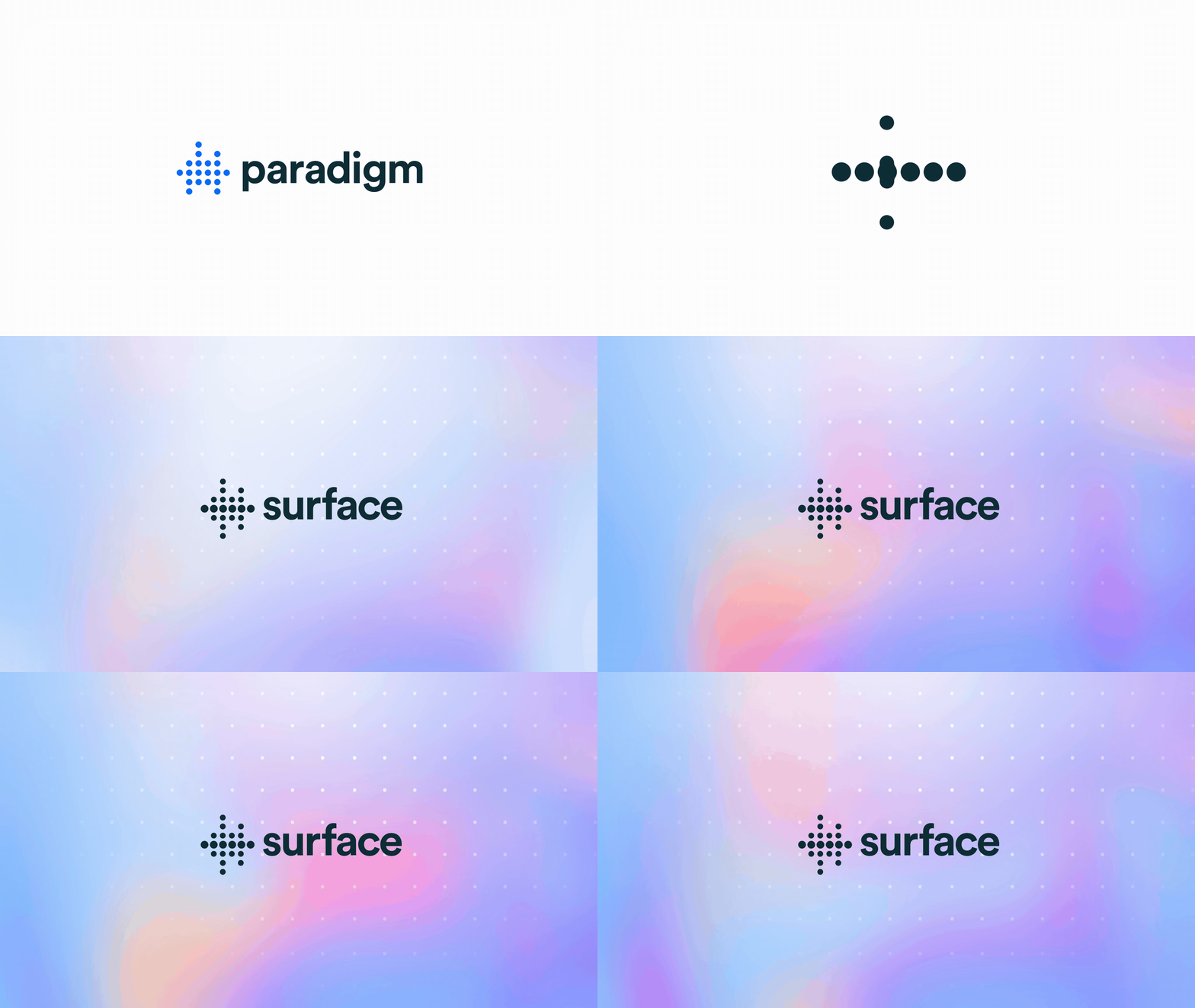
Our company is taking on the name of the platform we believe can put People teams in the best possible position to shape the next era of the function and their organizations.
The Next Era of People Leadership
We’re at a pivotal moment for organizations.
AI has the potential to fundamentally change how work gets done, but realizing that potential will require much more than deploying new technology. Some of the hardest parts of this transformation are cultural: helping people build new skills, rethinking how teams operate, changing expectations, and creating the conditions for people to work differently.
At the same time, as AI makes it cheaper and faster to build, create, and execute, we believe talent becomes an even more important source of competitive advantage. The companies that win won’t just be the ones with access to the best technology. They’ll be the ones that can attract exceptional people, organize them well, help them adapt, and create the conditions for them to do their best work.
That puts the People team in a uniquely strategic position.
They should be at the helm of this next phase of organizational evolution: helping define how work changes, what capabilities the organization needs, how leaders lead, and how culture evolves alongside the technology.
But the systems available to People teams weren’t built for this moment.
Workforce data remains fragmented across dozens of systems. Critical context lives in people’s heads, documents, policies, processes, and institutional knowledge. Traditional analytics tell you what happened only after someone knows which question to ask. And even when a team gets the right insight, figuring out what to do next requires another layer of expertise.
Surface gives People teams a fundamentally better way to operate.
It connects workforce data, company context, market data, and deep expertise to help organizations understand what’s happening across their workforce, why it matters, and what to do about it.
Instead of waiting for someone to run the right report or ask the right question, Surface can proactively flag what matters. Instead of treating people data like rows in a spreadsheet, Surface builds a nuanced understanding of the organization itself: its teams, leaders, processes, definitions, norms, and relationships. And instead of stopping at an insight, Surface helps teams move from understanding to action.
The six months since launching Surface have only strengthened our conviction in what we’re building.
Nearly 60 organizations across industries are now using the platform. We’ve added employee listening capabilities that help organizations move beyond a century-old survey model, integrated learning so workforce insights can translate directly into employee development, and continued to expand a proprietary set of benchmarks and insights about what works across organizations.
I’m incredibly proud of what our team has built, and grateful to the clients who saw the promise of Surface early. And we’re just getting started.
Our goal is to give every People team an intelligence layer for their organization: one that understands the company, gets smarter as the organization changes, and helps leaders make better decisions about their people and their business.
And while Paradigm will no longer be our company name, it will remain an important part of how we deliver on that vision.
Paradigm is Still Here!
AI is only as good as the context and expertise around it.
And as any leader who has been told to “just use AI” has learned, using these tools to drive real organizational change is very different from using them to make an existing task a little faster.
As teams across the business adopt purpose-built AI tools, they need help rethinking the work itself. The People function is no different.
A technology team can help with security, integrations, architecture, and data. But it can’t tell a People leader how to redesign employee listening. It can’t decide which parts of hiring should be automated and which should remain human. It can’t define what great management looks like. And it can’t lead the change required to bring those decisions to life.
That work requires deep expertise in people, talent, culture, and organizational change.
That’s where Paradigm comes in.
Paradigm is now Surface’s consulting and advisory practice, bringing more than a decade of experience helping organizations solve their hardest people and culture challenges.
Our consulting team will continue doing the work our clients know and trust, while also helping leaders navigate the organizational changes AI is creating. Just as importantly, that expertise will continue to shape Surface itself, ensuring the product is grounded in real-world judgment, proven practices, and the complexity of how organizations actually work.
What Changes?
If you’re a current customer, not much. The team you trust is still here, with an even bigger ambition: to give you the expertise, intelligence, and tools to build stronger organizations and lead through what comes next.
Over the coming weeks, you’ll start to see the Surface name across our emails, content, events, and products.
Our name is changing, but our founding vision isn’t. We still believe the team you build is the company you build, and that People teams can play a far more strategic role in shaping what their organizations become.
What has changed is what we believe is now possible.
Surface is our answer to that opportunity, and we couldn’t be more excited for what comes next.
To everyone who has been part of Paradigm’s first 12 years, and especially those joining us for this next chapter, thank you.

Joelle Emerson
Co-founder & CEO, Paradigm
Before founding Paradigm, Joelle was a civil rights lawyer. Joelle’s legal background highlighted the consequences that can result from companies failing to consider culture early, and inspired her to found Paradigm.
Get new posts by email
Research, product news, and practical strategy for people leaders. A few times a month, no more.
More from the blog

Announcements
Introducing Surface Listening: It’s Time to Rethink the Employee Survey
Engagement, attrition, and transformation don’t run on a calendar. Why do your surveys?

Insights
Build vs. Buy AI: A Framework for Enterprise Software
AI has made it dramatically easier for companies to build their own software, and that creates a new problem: companies building far more than they should. Six questions to ask before you build instead of buy.

Leadership
From HR Leader to Transformation Architect: The New Role of the Chief People Officer
As AI reshapes how work gets done, the Chief People Officer’s role is expanding. Discover the three critical responsibilities CPOs should own to help organizations adapt and thrive.